



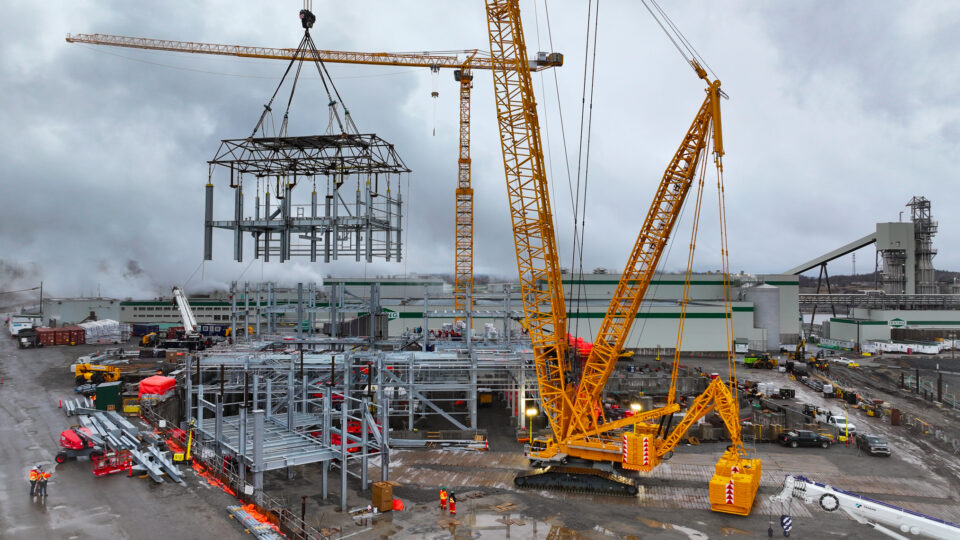
As the global pulp industry has grown bigger, faster and more efficient over the past few decades, smaller operations were left with a choice: transform or leave the business. Irving Pulp & Paper has chosen to transform in a big way. With the help of the Canada Infrastructure Bank (CIB), the transformation is redefining what the Canadian forest products industry looks like for decades to come.
Last year, Irving Pulp & Paper began construction on Project NextGen, a $1.5-billion generational upgrade to its west side pulp mill in Saint John, N.B., and the largest investment in the Canadian forest products industry in more than 30 years. CIB’s $660 million loan is playing an important role in making it happen.
Key components of the project involve the construction of a new recovery boiler, steam turbine and green energy generator, setting a solid foundation for the mill for the next 40 years and positioning the mill as a global leader in kraft pulp production and environmental performance.
“You cannot make those kinds of changes without a massive shift in technology,” said Mark Mosher, Executive Vice President of J.D. Irving, Limited’s (JDI) Pulp and Paper Division. “And that shift is what makes everything else possible.”
A mill has operated at the west Saint John location since the 1800s, becoming a pulp mill in the early 20th century. Purchased by JDI 80 years ago, the pulp mill’s current form dates to a major modernization in the early 1970s, with a significant environmental upgrade in the mid-1990s. But in terms of actual production output, not much changed in the last few decades.
Meanwhile, top performing mills worldwide were investing and growing their operations, outpacing Irving Pulp & Paper. A once-competitive operation quietly slipped from the top quarter of global producers to among the lowest. It became clear that fundamental transformation was the only path forward.
Enter Project NextGen: the fourth phase of a decade-spanning series of major mill upgrades and the largest by far. In short, NextGen will move the mill from the bottom quartile of global kraft pulp producers to the top, entering the global sweet spot for sustainable, competitive pulp production.
And the transformation goes well beyond pulp production. At the centre of the project is a new recovery boiler, steam turbine and generator that will produce up to 140 megawatts of clean, renewable electricity to fully power the mill and supply the surplus to the New Brunswick electrical grid. Further planned environmental improvements will halve greenhouse gas emissions per tonne of kraft pulp and deliver further improvements in air, sound and water quality.
A project of this size is an investment in its community. Beyond the environmental benefits, NextGen’s construction will generate jobs with an estimated 2,200 person-years of direct labour over roughly four and a half years, doubling the mill’s workforce on site at peak. It means sustained opportunities for local tradespeople and trades apprentices, helping to build the local skilled trades talent pipeline.
By the numbers, the project is expected to generate $539 million in employment income, $409 million in household spending at local businesses and boost provincial GDP by $711 million.
When complete, Project NextGen will add 600 jobs across the forest supply chain. This is because a stronger, more competitive pulp mill anchors the entire regional forest products chain by providing a regional market for woodchips, bark and pulpwood. This in turn strengthens sawmills and enables continued investment in forestry and silviculture across the province.
“A strong pulp mill makes a strong forest industry,” Mosher said.
Project NextGen positions the Saint John’s west side pulp mill for the future. It represents a commitment to the workers who have kept this mill running throughout its history, to the communities that have grown alongside it and the broader Canadian forest products sector.
The project will increase the green energy it generates, making it one of the top producing kraft pulp mills in the world, said Ron Marcolin, Vice-President of the Canadian Manufacturers and Exporters.
“Saint John punches above its weight as we speak. This will take it even higher.”
And it’s a vote of confidence in our community, added Shannon Merrifield, CEO, Saint John Region Chamber of Commerce.
“NextGen was a welcome announcement to our business community, signalling a belief that the region is a great place to do business.”