


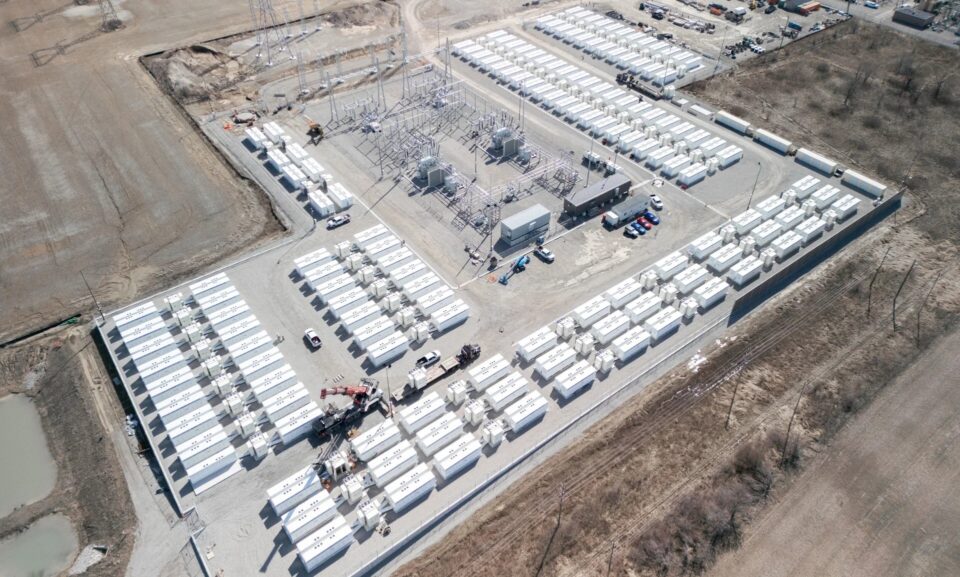
Oneida Energy Storage was never just about adding large batteries to Ontario’s electricity grid. It was a test—of a technology, a financing model and a theory about how public capital can pull entire markets into existence.
When the 250‑megawatt facility reached financial close in 2023, grid‑scale energy storage was still a novelty in Canada. Developers were interested, utilities were curious, but private capital remained wary. The Canada Infrastructure Bank (CIB) stepped in where markets hesitated—absorbing risk, structuring contracts and proving that storage could work not just technically, but financially.
The payoff has been larger than Oneida itself.
“What we learned from Oneida is now filtering into everything else we do,” says Ehren Cory, CEO, CIB. “The principles are the same, even if the assets are different. We’re not trying to pick winners. We’re trying to fix bottlenecks—and once those are cleared, markets can do what they’re supposed to do.”
At the time the CIB became involved, Oneida was already years in development. What it lacked was a financing structure banks were willing to touch. Energy storage was a new asset class in Canada, with few precedents for long‑term contracts, construction risk, or exposure to volatile critical‑mineral prices.
Lithium costs were climbing rapidly, threatening to sink economics built on long‑term system value rather than short‑term commodity cycles. The CIB’s solution was to structure financing that could absorb those near‑term swings—insulating the project long enough for its strategic importance to outweigh market noise. In May 2023, the CIB committed up to $518 million.
For the project’s private sector developers, that commitment changed everything.
“The CIB’s involvement was the single most important step in achieving success,” says Joseph Arcuri, chief financial officer, NRStor, which co‑developed Oneida alongside the Six Nations of the Grand River Development Corp. “They underwrote much of the construction risk, which—given this was the first project of its kind—was a significant hurdle.”
Once that risk was absorbed, lenders moved in. Commercial banks followed. Equity returns became predictable enough to make the numbers work.
No partner felt the impact more directly than Six Nations of the Grand River.
Through its development corporation, launched in 2015 to build economic self‑sufficiency without compromising community values, Six Nations became a co‑owner of Oneida—and, in the process, one of the country’s most significant energy storage investors.
Today, the corporation holds stakes in 28 wind, solar and battery energy projects totalling more than 2.5 gigawatts of capacity.
Among them are the 211‑megawatt Hedley facility in Haldimand County and the 300‑megawatt Hagersville site, which has since surpassed Oneida to become Canada’s largest energy storage project.
“So, we’re co‑investors in the two largest battery storage projects in the country,” says Matt Jamieson, President and Chief Executive Officer.
Six Nations has also partnered with Blackstone‑backed Aypa Power on two additional projects, supported by roughly $700 million in financing from an eight‑bank syndicate led by CIBC.
Three years after financial close, energy storage has shifted from fringe technology to a central pillar of electricity planning in Ontario—and increasingly across Canada.
That was the intention.
The CIB’s strategy is not to remain a permanent source of capital, but a temporary one—stepping in early, shaping risk and stepping back once markets learn how to price it. Ehren Cory describes the institution as an impact investor, focused on infrastructure “that would otherwise take longer or not move forward at all.”
Oneida worked because several pieces locked into place at once. A long‑term capacity contract from Ontario’s Independent Electricity System Operator (IESO) provided predictable revenue. The CIB’s financing absorbed early construction and pricing risk. Together, they created a structure capable of supporting a project at unprecedented scale.
Once operational, the facility proved its value quickly—delivering firm capacity, smoothing renewable integration, and reducing reliance on gas‑fired peaking plants without requiring a fundamental rewrite of market rules.
“The CIB helped facilitate a financing structure that worked,” says Barb Ellard, the IESO’s director of resource and system adequacy. “And since then, we’ve seen banks and pension funds step forward to finance similar projects.”
With the province’s electricity demand projected to rise 65% by 2050, storage has emerged as a flexible bridge between renewable and nuclear supply. Within a year of Oneida’s financial close, Ontario launched the largest energy storage procurement in Canadian history, contracting about four gigawatts of capacity.
The same arc is playing out elsewhere. In transit, the CIB has backed zero‑emission bus fleets and commuter rail. In electric‑vehicle charging, it has tied repayment to adoption rates. In mining, its financing—alongside Export Development Canada—helped revive Québec’s Matawinie graphite project after private capital stalled.
From ports to airports, the pattern repeats: early capital, structured to tolerate risk, deployed where markets hesitate.
Critics argue the CIB is picking winners. The CIB disagrees. It’s role, it says, is narrower—and harder—focusing on structural gaps like missing contracts or mispriced risk.
Oneida shows that distinction clearly. It needed public capital to move first. The projects that came after did not.
Oneida was the proof of concept. The market that followed is the return.